Are schools ready for the new online Common Core tests?
 Credit: Alison Yin / EdSource (2014)
 Credit: Alison Yin / EdSource (2014)
California is just weeks abroad from learning whether its test of the test will pass or fail.
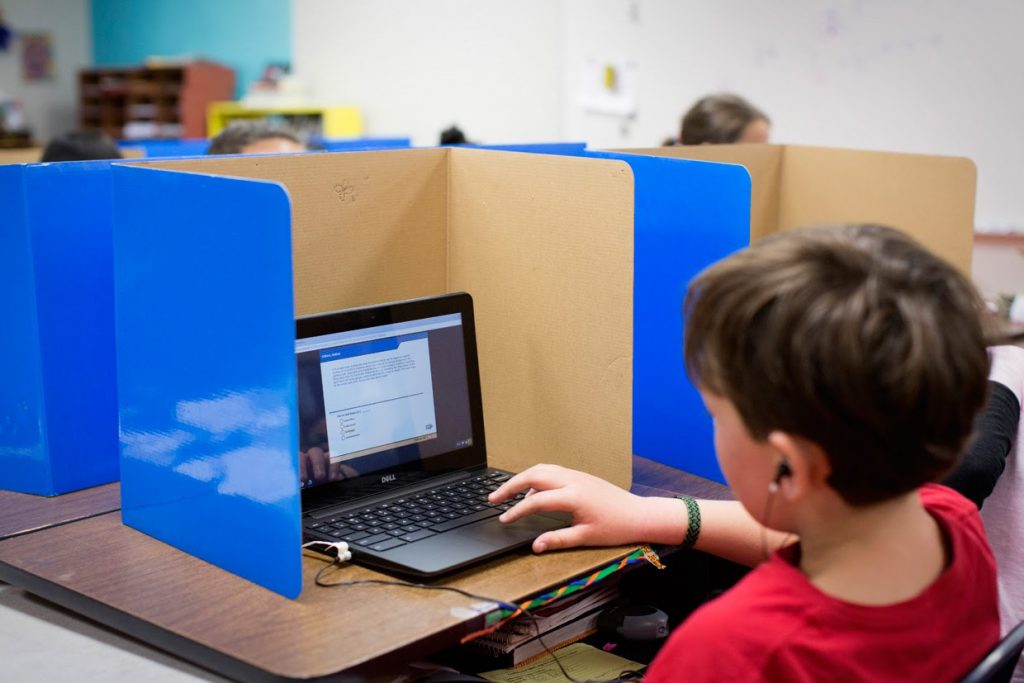
For nearly 12 weeks, beginning March 25, more than iii meg students in grades iii through 8 and xi volition take the calculator-based Smarter Counterbalanced field, or do, test aligned to the Common Cadre State Standards in math and English. But instead of assessing students' skills, this year only, the exam – which was delayed a calendar week from its previous March 18 start date – will be used to assist officials evaluate the quality of the test questions to ensure that they're valid and fair for all students, and it volition assess the capability of computers and engineering science linking the state's 10,000-plus schools to the Internet.

A grade four math practice question tests how well students understand factoring, divisibility and remainders. (Click to enlarge) Credit: Smarter Counterbalanced Cess Consortium.
Pupil scores won't matter until next jump, when the online tests officially replace the California Standards Tests and other assessments that formed the land's Standardized Testing and Reporting plan, known as STAR, for the past 15 years. Instead of the bubble-in, multiple-choice tests that take been the hallmark of standardized testing in the country, the online assessments volition require students to demonstrate a deeper level of knowledge through persuasive writing, problem solving and explaining how they constitute their answers.
Judging past the numbers, California appears to take at least the minimum technology needed for the examination. The latest figures from a survey conducted by the Section of Pedagogy show that 88 per centum of school districts and 83 percentage of schools are connected to the K-12 High Speed Network, a high-speed Internet connection for schools funded by the land Department of Education.
Behind the connectivity numbers, the standard of readiness is imprecise and inconsistent.
"What does 'ready' mean? That's what we're most to observe out," said David Plank, executive director of Policy Analysis for California Education, a nonpartisan, nonprofit research center. "I think we're all flying blind on this and we're going to find out what we're able to do."
(Meet companion piece on the skills students demand for the new examination.)
What is certain is that just being connected to the Grand-12 High Speed Network isn't enough. Hundreds of schools don't take sufficient computers, keyboards and headphones for all their students, or have sufficient bandwidth to run the data-heavy test that uses videos, animated graphics and interactive graphs in the questions. Some children volition be bused to other schools in their commune that accept better computer access. Some campuses are leasing mobile reckoner labs. However others are testing a few students at a time to avert a network crash.
"People are finding ways to have their students tested," said Deb Sigman, deputy superintendent of the California Department of Education. "We're not hearing horror stories from folks."
During this last mile before the field examination, Sigman said the Educational Testing Service, ETS, a state contractor helping districts gear up for the field examination, "has a squad of people doing site visits and helping schools discover creative solutions" to technological challenges.
Mobile computers, mobile students
California had the opportunity to take part in a free evaluation offered by the nonprofit EducationSuperHighway that would have identified schools without the necessary bandwidth to handle the Smarter Balanced field exam, but decided confronting it. Completing the cess would have taken each school a couple of minutes to log into the arrangement'south speed exam site and run the plan. Founded past entrepreneur Evan Marwell, the organisation received $nine million from the Gates and Zuckerberg foundations for its initiative to connect every school in the country to high-speed Internet.
California Section of Teaching spokesperson Tina Jung said the department opted out because it was focused on getting schools to complete the department's tech readiness survey, a self-reported inventory to determine if schools meet the minimum requirements for bandwidth, operating systems and available computers and other equipment.
"Nosotros were heavily promoting that, at the same time that the EducationSuperHighway came out. So we didn't want to overburden or confuse our schools during this critical time," Jung said.

California'southward One thousand-12 high-speed network uses the 3,800-mile California Research and Education Network, an Net just for schools, country colleges and universities and a few private colleges. Credit: The California Research and Didactics Network
In San Mateo County, 23 districts took the speed examination and found the results helped pinpoint their connectivity needs. The County Office of Pedagogy asked the districts to participate as office of a larger project to develop models of teaching using technology. Overall, the county's schools are in better shape than those in most of the land, although but nigh a third of schools have adequate bandwidth for the field test, co-ordinate to the EducationSuperHighway.
Every bit a direct issue of the speed test, San Mateo County districts on the borderline of readiness had time to improve their technology, said Brian Simmons, director of accountability, innovation and results for the County Office of Education.
"The adept thing almost this burn drill is that the organisation has responded," Simmons said. "I was in 1 district that had simply gotten a agglomeration of Chromebooks, so I think that (the speed examination) has had that impact."
At that place are even so a few outliers. Simmons said some 5 to x percent of the districts will demand support during testing, such equally using portable computer labs and bringing in mobile hotspots to expand bandwidth.
Creative solutions
A number of California districts are making do with MacGyver-like resourcefulness.
Cuyama Articulation Unified School Commune serves most 240 students in a remote farming customs surrounded past mountains in Santa Barbara Canton. As the crow flies, it's midway between Bakersfield, 64 miles to the east, and Santa Maria, 60 miles to the due west, which is also the nearest link to the Thou-12 High Speed Network. As network cables lie, well, fuggedaboutit.
When testing begins, the 101 students in grades 3-8 at Cuyama Unproblematic School will exist bused to the high school over several days to take the field test in Cuyama Valley High's figurer lab.
Death Valley Unified School District, which covers 6,000 square miles of the Mojave Desert and has skimpy cell phone service, is going to test its 20 students one at a time, said Cindy Kazanis, managing director of educational data management at the California Department of Teaching. The math and English sections are each expected to take three to four hours to complete and districts say they'll spread that out over several days. Fortunately, at virtually 12 weeks, the window for the field test is long enough to do this.
Suburban Sacramento'due south Natomas Unified School District has limited bandwidth, said Kazanis, and found that it couldn't test classrooms next to each other without crashing the computers, so the commune scheduled testing for every other classroom.
Matt Kinzie, chief technology officeholder for the about 57,000-educatee San Francisco Unified School District, said the commune "is feeling pretty confident well-nigh the field test." Well-nigh 15 schools don't have enough computers, so the district ordered laptops that can easily be moved from schoolhouse to schoolhouse during the testing period.
One potential pitfall is that San Francisco schools run at least 3 different operating systems: Apple tree, Windows and Google Chromebooks. The latter poses the biggest challenge because Chromebooks only operate in the cloud on Google's browser.
"I'm hoping nosotros don't have the same feel as Obamacare," Kinzie joked, a reference to website woes that plagued the roll-out of the wellness intendance program.
Kazanis is also advising districts with minimum bandwidth to endeavor to keep the network as open as possible during testing by holding off on some administrative tasks.
"Keep in mind that the networks are already being utilized to a certain capacity and this takes it above and across that, so office of the guidance that nosotros've been giving is don't exercise your payroll Mon forenoon when getting ready to take the large test," Kazanis said.
The state does take emergency plans for the testing period in the effect that a student presses a key and his or her screen goes blank, or the network freezes and there's no tech expert on site. ETS specialists will exist on manus through a price-gratuitous number on the California Technical Assistance website.
Just a few billion more
A mutual thread linking districts with technology gaps is money; more than specifically, non enough of information technology.
San Francisco Unified has spent $836,000 this twelvemonth for new computers, keyboards and headsets for testing, and has plans to buy five,300 Apple computers adjacent year to first standardizing the district on a single operating system.
Cuyama Joint Unified bought 28 new computers this year for the high school lab. Superintendent Roland Maier said he wants to add together a lab at the elementary schoolhouse and make other system upgrades, at a cost of tens of thousands of dollars.
Both districts used their portion of funds from the $1.25 billion erstwhile Mutual Core implementation grant that Gov. Jerry Brown put into the May upkeep revision concluding bound. That money, about $200 per student, could exist used for engineering science, professional person development and textbooks or other instructional materials.
"What I'g hoping more than anything is that the governor will decide to put another $ane.25 or $two billion into (implementation)," Maier said, "because nosotros need a lot more and I know well-nigh schools exercise demand a lot more."
Assemblywoman Susan Bonilla, D-Agree, who advocated for the funding concluding year, said she's heard that appeal from many superintendents, principals and teachers. Earlier this month, she introduced legislation seeking another one-time round of transition funds to implement Common Core State Standards. Assembly Nib 2319 doesn't list a specific dollar corporeality, but in an interview, Bonilla said she'd similar an additional $one.v billion, which is what she had hoped for last yr.
That will only cover half of what schools need to gear up for Common Core, contends Wes Smith, executive director of the Association of California School Administrators. ACSA is calling for two set-asides: $1.5 billion for applied science and $1.25 billion for professional person evolution, curriculum development and instructional materials.
He said superintendents told him they're worried that without adequate preparation California volition "suffer the same fate as other states" – New York in detail, which caused a backlash against Common Core past testing students before they were ready.
Equity issues
Smith'southward fundamental concern, however, is the consequences of an diff distribution of technology for the country's poorest students, and not just on the field test, merely also having access to the full potential of the new standards. Technology skills, from bones keyboarding to research, are embedded throughout Common Core.
"We believe at the heart of all this is opportunity. We're at a crossroads where we can provide opportunity for all children and really invest in a real transition," Smith said. "Nosotros're really concerned here that nosotros have a civil rights event brewing that some of our wealthiest communities take access to technology and have for some time."
Low-income students and their schools could experience that deficit adjacent bound when the Smarter Balanced assessment is graded. During the first iii years of the actual exam, schools tin requite a traditional newspaper-and-pencil version, but those students will miss out on familiarizing themselves with the online version, which volition be required in 2018, and they'll lose opportunities for personalized learning. The computerized version of the test is adaptive; it adjusts the difficulty of questions based on students' answers. That gives teachers more than data virtually where their students demand help.
"We don't see any world where that's equitable," Smith said.
State officials signal out that the purpose of the field test is to get an accurate bookkeeping of each school's technological capabilities earlier the test has consequences then there's time to address the glitches.
"For the most part districts see this equally a great opportunity," said CDE's Kazanis. "If something is going to fail, this is the year for that to occur. Mistakes are going to happen and nosotros want to brand them when the stakes are low."
Contact senior reporter Kathryn Businesswoman and follow her on Twitter @TchersPet . Sign up hither for a no-toll online subscription to EdSource Today for reports from the largest didactics reporting team in California.
To get more reports like this one, click here to sign up for EdSource's no-price daily email on latest developments in pedagogy.
Source: https://edsource.org/2014/are-schools-ready-for-the-new-online-common-core-tests-2/63454
0 Response to "Are schools ready for the new online Common Core tests?"
Enviar um comentário