How Did the Rise of Christianity Impact Medieval Art
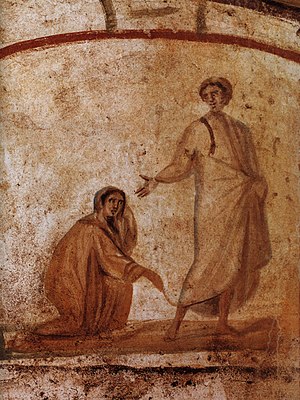
Early Christian art and compages or Paleochristian art is the art produced by Christians or under Christian patronage from the earliest period of Christianity to, depending on the definition used, erstwhile between 260 and 525. In do, identifiably Christian art only survives from the 2d century onwards.[1] After 550 at the latest, Christian art is classified as Byzantine, or of another regional blazon.[1] [ii]
It is hard to know when distinctly Christian art began. Prior to 100, Christians may have been constrained by their position equally a persecuted group from producing durable works of art. Since Christianity was largely a organized religion non well represented in the public sphere,[ citation needed ] the lack of surviving art may reflect a lack of funds for patronage, and merely small numbers of followers. The Onetime Testament restrictions against the production of graven (an idol or fetish carved in forest or rock) images (see likewise Idolatry and Christianity) may also take constrained Christians from producing art. Christians may accept made or purchased art with pagan iconography, simply given it Christian meanings, as they later did. If this happened, "Christian" fine art would not exist immediately recognizable as such.
Early Christianity used the aforementioned artistic media equally the surrounding pagan civilisation. These media included fresco, mosaics, sculpture, and manuscript illumination. Early on Christian fine art used non only Roman forms simply besides Roman styles. Tardily classical style included a proportional portrayal of the man body and impressionistic presentation of space. Late classical style is seen in early Christian frescos, such as those in the Catacombs of Rome, which include most examples of the earliest Christian art.[3] [4] [five]
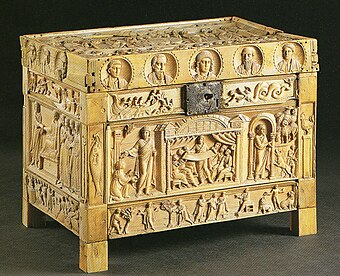
Early Christian art and architecture adapted Roman artistic motifs and gave new meanings to what had been pagan symbols. Among the motifs adopted were the peacock, Vitis viniferavines, and the "Expert Shepherd". Early Christians as well developed their own iconography; for case, such symbols as the fish (ikhthus) were not borrowed from heathen iconography.
Early Christian art is generally divided into ii periods by scholars: earlier and after either the Edict of Milan of 313, bringing the so-called Triumph of the Church building nether Constantine, or the Offset Quango of Nicea in 325. The earlier catamenia being called the Pre-Constantinian or Ante-Nicene Flow and after being the menses of the Beginning seven Ecumenical Councils.[6] The end of the period of early Christian fine art, which is typically defined by art historians every bit being in the fifth–7th centuries, is thus a good bargain later than the end of the period of early Christianity as typically defined by theologians and church historians, which is more often considered to terminate under Constantine, effectually 313–325.
Symbols [edit]

During the persecution of Christians nether the Roman Empire, Christian art was necessarily and deliberately furtive and cryptic, using imagery that was shared with pagan culture merely had a special pregnant for Christians. The earliest surviving Christian fine art comes from the tardily 2nd to early 4th centuries on the walls of Christian tombs in the catacombs of Rome. From literary bear witness, in that location may well have been panel icons which, like almost all classical painting, accept disappeared. Initially Jesus was represented indirectly by pictogram symbols such every bit the Ichthys (fish), peacock, Lamb of God, or an anchor (the Labarum or Chi-Rho was a later development). Later personified symbols were used, including Jonah, whose three days in the abdomen of the whale pre-figured the interval between the death and resurrection of Jesus, Daniel in the lion's den, or Orpheus' charming the animals. The epitome of "The Good Shepherd", a beardless youth in pastoral scenes collecting sheep, was the most common of these images, and was probably not understood as a portrait of the historical Jesus.[7] These images bear some resemblance to depictions of kouros figures in Greco-Roman art. The "most total absence from Christian monuments of the period of persecutions of the plain, unadorned cross" except in the disguised class of the ballast,[viii] is notable. The Cross, symbolizing Jesus' crucifixion on a cross, was non represented explicitly for several centuries, perhaps because crucifixion was a punishment meted out to common criminals, only too considering literary sources noted that it was a symbol recognised as specifically Christian, every bit the sign of the cross was fabricated by Christians from very early.
The popular formulation that the Christian catacombs were "secret" or had to hide their affiliation is probably wrong; catacombs were large-calibration commercial enterprises, unremarkably sited just off major roads to the metropolis, whose existence was well known. The inexplicit symbolic nature of many early Christian visual motifs may have had a office of discretion in other contexts, but on tombs, they probably reflect a lack of whatsoever other repertoire of Christian iconography.[nine]
The dove is a symbol of peace and purity. It can be found with a halo or celestial low-cal. In one of the earliest known Trinitarian images, "the Throne of God as a Trinitarian paradigm" (a marble relief carved c. 400 CE in the collection of the Prussian Cultural Heritage Foundation), the pigeon represents the Spirit. It is flying above an empty throne representing God, in the throne are a chlamys (cloak) and diadem representing the Son. The Chi-Rho monogram, XP, apparently first used by Constantine I, consists of the start two characters of the name 'Christos' in Greek.
Christian art earlier 313 [edit]
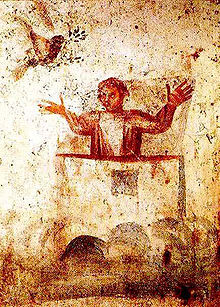
Noah praying in the Ark, from a Roman catacomb
A general assumption that early Christianity was generally aniconic, opposed to religious imagery in both theory and practice until well-nigh 200, has been challenged by Paul Corby Finney's assay of early Christian writing and textile remains (1994). This distinguishes iii unlike sources of attitudes affecting early Christians on the upshot: "first that humans could have a straight vision of God; second that they could not; and, third, that although humans could see God they were all-time brash non to look, and were strictly forbidden to represent what they had seen". These derived respectively from Greek and Near Eastern heathen religions, from Ancient Greek philosophy, and from the Jewish tradition and the One-time Testament. Of the three, Finney concludes that "overall, Israel'southward aversion to sacred images influenced early on Christianity considerably less than the Greek philosophical tradition of invisible deity apophatically defined", then placing less emphasis on the Jewish background of most of the first Christians than most traditional accounts.[ten] Finney suggests that "the reasons for the non-appearance of Christian art earlier 200 have nothing to practise with principled aversion to art, with other-worldliness, or with anti-materialism. The truth is simple and mundane: Christians lacked country and capital letter. Art requires both. As soon as they began to learn country and capital letter, Christians began to experiment with their own distinctive forms of art".[xi]
In the Dura-Europos church, of about 230–256, which is in the best status of the surviving very early churches, there are frescos of biblical scenes including a effigy of Jesus, as well every bit Christ every bit the Skilful Shepherd. The building was a normal house apparently converted to use every bit a church.[12] [thirteen] The earliest Christian paintings in the Catacombs of Rome are from a few decades earlier, and these represent the largest trunk of examples of Christian art from the pre-Constantinian period, with hundreds of examples decorating tombs or family tomb-chambers. Many are unproblematic symbols, just there are numerous figure paintings either showing orants or female praying figures, commonly representing the deceased person, or figures or shorthand scenes from the bible or Christian history.
The style of the crypt paintings, and the entirety of many decorative elements, are effectively identical to those of the catacombs of other religious groups, whether conventional pagans post-obit Ancient Roman religion, or Jews or followers of the Roman mystery religions. The quality of the painting is low compared to the large houses of the rich, which provide the other main corpus of painting surviving from the menstruation, only the shorthand depiction of figures tin can have an expressive charm.[14] [15] [16] A similar situation applies at Dura-Europos, where the decoration of the church is comparable in manner and quality to that of the (larger and more lavishly painted) Dura-Europos synagogue and the Temple of Bel. At least in such smaller places, information technology seems that the available artists were used by all religious groups. It may also have been the case that the painted chambers in the catacombs were busy in similar fashion to the best rooms of the homes of the better-off families cached in them, with Christian scenes and symbols replacing those from mythology, literature, paganism and eroticism, although nosotros lack the evidence to confirm this.[17] [xviii] [nineteen] We do accept the aforementioned scenes on modest pieces in media such every bit pottery or glass,[20] though less often from this pre-Constantinian period.
There was a preference for what are sometimes called "abbreviated" representations, pocket-sized groups of say i to 4 figures forming a single motif which could be easily recognised as representing a particular incident. These vignettes fitted the Roman style of room ornamentation, set in compartments in a scheme with a geometrical structure (encounter gallery beneath).[21] Biblical scenes of figures rescued from mortal danger were very pop; these represented both the Resurrection of Jesus, through typology, and the salvation of the soul of the deceased. Jonah and the whale,[22] [23] the Sacrifice of Isaac, Noah praying in the Ark (represented as an orant in a large box, perchance with a pigeon carrying a branch), Moses striking the stone, Daniel in the lion's den and the Iii Youths in the Fiery Furnace ([Daniel 3:10–thirty]) were all favourites, that could exist hands depicted.[24] [25] [21] [26] [27]
Early Christian sarcophagi were a much more expensive option, made of marble and frequently heavily decorated with scenes in very high relief, worked with drills. Free-standing statues that are unmistakably Christian are very rare, and never very large, as more common subjects such every bit the Expert Shepherd were symbols appealing to several religious and philosophical groups, including Christians, and without context no affiliation tin be given to them. Typically sculptures, where they appear, are of rather high quality. I exceptional group that seems conspicuously Christian is known as the Cleveland Statuettes of Jonah and the Whale,[28] [21] and consists of a group of small statuettes of most 270, including two busts of a young and fashionably dressed couple, from an unknown notice-spot, possibly in modernistic Turkey. The other figures tell the story of Jonah in four pieces, with a Good Shepherd; how they were displayed remains mysterious.[29]
The depiction of Jesus was well-developed past the end of the pre-Constantinian period. He was typically shown in narrative scenes, with a preference for New Testament miracles, and few of scenes from his Passion. A variety of different types of appearance were used, including the thin long-faced figure with long centrally-parted hair that was later to become the norm. But in the earliest images as many show a stocky and short-haired beardless figure in a short tunic, who can only be identified by his context. In many images of miracles Jesus carries a stick or wand, which he points at the field of study of the phenomenon rather like a modern phase magician (though the wand is a good deal larger).
Saints are adequately ofttimes seen, with Peter and Paul, both martyred in Rome, by some way the most common in the catacombs in that location. Both already have their distinctive appearances, retained throughout the history of Christian art. Other saints may not be identifiable unless labelled with an inscription. In the same style some images may represent either the Last Supper or a gimmicky agape feast.
-

-

Moses striking the rock in the desert, a epitome of baptism[31]
-
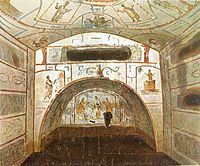
Catacomb chamber with (from top): Orants, Jonah and the Whale, Moses striking the rock (left), Noah praying in the ark, Adoration of the Magi. 200–250
Christian architecture after 313 [edit]
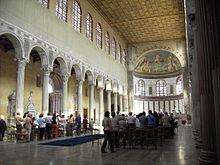
In the 4th century, the speedily growing Christian population, now supported by the country, needed to build larger and grander public buildings for worship than the mostly discreet meeting places they had been using, which were typically in or among domestic buildings. Pagan temples remained in use for their original purposes for some time and, at least in Rome, fifty-fifty when deserted were shunned past Christians until the 6th or seventh centuries, when some were converted to churches.[32] Elsewhere this happened sooner. Architectural formulas for temples were unsuitable, non simply for their infidel associations, simply because pagan cult and sacrifices occurred outdoors under the open sky in the sight of the gods, with the temple, housing the cult figures and the treasury, equally a windowless backdrop.
The usable model at paw, when Emperor Constantine I wanted to memorialize his imperial piety, was the familiar conventional architecture of the basilica. There were several variations of the bones programme of the secular basilica, always some kind of rectangular hall, but the one usually followed for churches had a center nave with i alley at each side, and an apse at one end opposite to the main door at the other. In, and oft too in front of, the alcove was a raised platform, where the altar was placed and the clergy officiated. In secular buildings this program was more typically used for the smaller audience halls of the emperors, governors, and the very rich than for the peachy public basilicas performance as law courts and other public purposes.[33] This was the normal pattern used for Roman churches, and more often than not in the Western Empire, merely the Eastern Empire, and Roman Africa, were more adventurous, and their models were sometimes copied in the West, for example in Milan. All variations allowed natural lite from windows high in the walls, a departure from the windowless sanctuaries of the temples of most previous religions, and this has remained a consistent characteristic of Christian church compages. Formulas giving churches with a large central surface area were to become preferred in Byzantine architecture, which developed styles of basilica with a dome early on.[34]

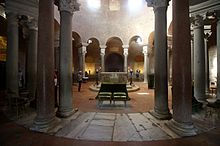
A particular and brusk-lived type of building, using the same basilican class, was the funerary hall, which was non a normal church, though the surviving examples long ago became regular churches, and they e'er offered funeral and memorial services, but a building erected in the Constantinian period as an indoor cemetery on a site connected with early Christian martyrs, such every bit a catacomb. The six examples built by Constantine outside the walls of Rome are: Old Saint Peter'south Basilica, the older basilica defended to Saint Agnes of which Santa Costanza is now the just remaining element, San Sebastiano fuori le mura, San Lorenzo fuori le Mura, Santi Marcellino due east Pietro al Laterano, and i in the modern park of Villa Gordiani.[35]
A martyrium was a building erected on a spot with detail significance, oft over the burial of a martyr. No particular architectural course was associated with the type, and they were oft small. Many became churches, or chapels in larger churches erected bordering them. With baptistries and mausolea, their often smaller size and different function made martyria suitable for architectural experimentation.[36]
Amid the key buildings, not all surviving in their original form, are:
- Constantinian Basilicas:
- Archbasilica of Saint John Lateran
- St Mary Major
- Old Saint Peter's Basilica
- Church of the Holy Sepulchre
- Church of the Nativity
- Saint Sofia Church, Sofia
- Centralized Plan
- Santa Constanza, built every bit an Royal mausoleum adjoining a funerary hall, part of the wall of which survives.[37]
- Church of St. George, Sofia
Christian art after 313 [edit]
With the concluding legalization of Christianity, the existing styles of Christian art continued to develop, and take on a more monumental and iconic character. Before long very big Christian churches began to be synthetic, and the majority of the rich elite adapted Christianity, and public and elite Christian art became grander to suit the new spaces and clients.
Although borrowings of motifs such equally the Virgin and Kid from pagan religious art had been pointed out as far back as the Protestant Reformation, when John Calvin and his followers gleefully used them every bit a stick with which to beat all Christian art, the belief of André Grabar, Andreas Alföldi, Ernst Kantorowicz and other early on 20th-century fine art historians that Roman Royal imagery was a much more significant influence "has get universally accepted". A book by Thomas F. Mathews in 1994 attempted to overturn this thesis, very largely denying influence from Imperial iconography in favour of a range of other secular and religious influence, but was roughly handled by academic reviewers.[38]
More circuitous and expensive works are seen, as the wealthy gradually converted, and more than theological complication appears, as Christianity became field of study to acrimonious doctrinal disputes. At the same time a very different type of art is found in the new public churches that were now existence synthetic. Somewhat by blow, the best group of survivals of these is from Rome where, together with Constantinople and Jerusalem, they were presumably at their most magnificent. Mosaic now becomes of import; fortunately this survives far improve than fresco, although it is vulnerable to well-meaning restoration and repair. Information technology seems to have been an innovation of early Christian churches to put mosaics on the wall and use them for sacred subjects; previously, the technique had essentially been used for floors and walls in gardens. By the end of the period the fashion of using a gold basis had developed that continued to characterize Byzantine images, and many medieval Western ones.
With more space, narrative images containing many people develop in churches, and as well begin to exist seen in afterwards catacomb paintings. Continuous rows of biblical scenes announced (rather high up) forth the side walls of churches. The best-preserved 5th-century examples are the set of One-time Testament scenes along the nave walls of Santa Maria Maggiore in Rome. These can be compared to the paintings of Dura-Europos, and probably also derive from a lost tradition of both Jewish and Christian illustrated manuscripts, as well equally more general Roman precedents.[39] [twoscore] The large apses contain images in an iconic style, which gradually developed to center on a large figure, or subsequently just the bust, of Christ, or afterwards of the Virgin Mary. The earliest apses evidence a range of compositions that are new symbolic images of the Christian life and the Church.
No panel paintings, or "icons" from before the 6th century have survived in anything similar an original condition, just they were clearly produced, and condign more of import throughout this menses.
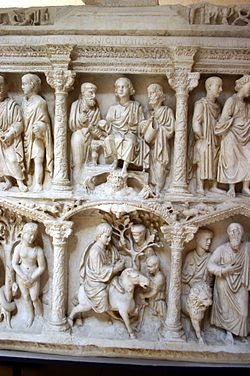
Sculpture, all much smaller than lifesize, has survived in better quantities. The nigh famous of a considerable number of surviving early Christian sarcophagi are maybe the Sarcophagus of Junius Bassus and Dogmatic sarcophagus of the quaternary century. A number of ivory carvings have survived, including the complex tardily-fifth-century Brescia Casket, probably a product of Saint Ambrose's episcopate in Milan, and then the seat of the Imperial courtroom, and the 6th-century Throne of Maximian from the Byzantine Italian upper-case letter of Ravenna.
- Manuscripts
- Quedlinburg Itala fragment – fifth-century Erstwhile Testament
- Vienna Genesis
- Rossano Gospels
- Cotton wool Genesis
- Late Antique mosaics in Italy and Early Byzantine mosaics in the Eye E.
Gold drinking glass [edit]
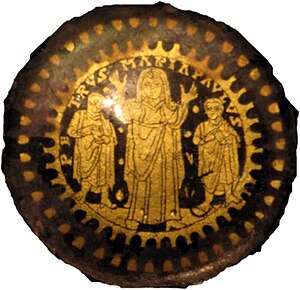
Gold sandwich drinking glass or golden glass was a technique for fixing a layer of gold leaf with a blueprint between ii fused layers of drinking glass, developed in Hellenistic glass and revived in the 3rd century. In that location are a very fewer larger designs, just the neat majority of the around 500 survivals are roundels that are the cutting-off bottoms of wine cups or glasses used to marker and decorate graves in the Catacombs of Rome by pressing them into the mortar. The great bulk are 4th century, extending into the 5th century. Most are Christian, but many pagan and a few Jewish, and had probably originally been given as gifts on marriage, or festive occasions such equally New Year. Their iconography has been much studied, although artistically they are relatively unsophisticated.[41] Their subjects are similar to the crypt paintings, but with a departure balance including more portraiture of the deceased (usually, it is presumed). The progression to an increased number of images of saints tin can be seen in them.[42] The aforementioned technique began to be used for gold tesserae for mosaics in the mid-1st century in Rome, and past the 5th century these had get the standard background for religious mosaics.
See also [edit]
- Oldest churches in the earth
Notes [edit]
- ^ a b Jensen 2000, p. 15–sixteen.
- ^ van der Meer, F., 27 uses "roughly from 200 to 600".
- ^ Syndicus 1962, p. 10–14.
- ^ Syndicus 1962, p. xxx-32.
- ^ Jensen 2000, p. 12-xv.
- ^ Jensen 2000, p. 16.
- ^ Syndicus 1962, p. 21-23.
- ^ Marucchi, Orazio. "Archaeology of the Cross and Crucifix." The Catholic Encyclopedia. Vol. 4. New York: Robert Appleton Company, 1908. 7 Sept. 2018 online
- ^ Jensen 2000, p. 22.
- ^ Finney, eight–xii, viii and xi quoted
- ^ Finney, 108
- ^ Weitzmann 1979, p. no. 360.
- ^ Graydon F. Snyder, Ante pacem: archaeological evidence of church life before Constantine, p. 134, Mercer University Press, 2003, google books
- ^ Syndicus 1962, p. 29-thirty.
- ^ Jensen 2000, p. 24.
- ^ Beckwith 1979, p. 23–24.
- ^ Syndicus 1962, p. 10–11.
- ^ Jensen 2000, p. 10-15.
- ^ Balch, 183, 193
- ^ Weitzmann 1979, p. no. 377.
- ^ a b c Weitzmann 1979, p. 396.
- ^ Weitzmann 1979, p. no. 365.
- ^ Balch, 41 and chapter 6
- ^ Syndicus 1962, p. 15-eighteen.
- ^ Jensen 2000, p. Chapte three.
- ^ Weitzmann 1979, p. no. 360-407.
- ^ Beckwith 1979, p. 21-24.
- ^ Weitzmann 1979, p. no. 362-367.
- ^ Weitzmann 1979, p. 410.
- ^ Weitzmann 1979, p. no. 383.
- ^ Weitzmann 1979, p. 424-425.
- ^ Syndicus 1962, p. 39.
- ^ Syndicus 1962, p. 40.
- ^ Syndicus 1962, chapter II, covers the whole story of the Christianization of the basilica..
- ^ Webb, Matilda. The churches and catacombs of early Christian Rome: a comprehensive guide, p. 251, 2001, Sussex Academic Press, ISBN 1-902210-58-ane, ISBN 978-1-902210-58-two, google books
- ^ Syndicus 1962, chapter Three.
- ^ Syndicus 1962, p. 69-70.
- ^ The book was The Clash of Gods: A Reinterpretation of Early Christian Fine art by Thomas F. Mathews. Review by: W. Eugene Kleinbauer (quoted, from p. 937), Speculum, Vol. seventy, No. 4 (Oct., 1995), pp. 937-941, Medieval Academy of America, JSTOR; JSTOR has other reviews, all with criticisms along similar lines: Peter Brown, The Art Bulletin, Vol. 77, No. iii (Sep., 1995), pp. 499–502; RW. Eugene Kleinbauer, Speculum, Vol. seventy, No. 4 (October., 1995), pp. 937–941, Liz James, The Burlington Mag, Vol. 136, No. 1096 (Jul., 1994), pp. 458–459;Annabel Wharton, The American Historical Review, Vol. 100, No. 5 (Dec., 1995), pp. 1518–1519 .
- ^ Syndicus 1962, p. 52-54.
- ^ Weitzmann 1979, p. 366-369.
- ^ Beckwith 1979, p. 25-26.
- ^ Grig, throughout
References [edit]
- Balch, David 50., Roman Domestic Fine art & Early House Churches (Wissenschaftliche Untersuchungen zum Neuen Testament Serial), 2008, Mohr Siebeck, ISBN 3161493834, 9783161493836
- Beckwith, John (1979). Early Christian and Byzantine Fine art (2d ed.). Yale University Press. ISBN0140560335.
- Finney, Paul Corby, The Invisible God: The Earliest Christians on Art, Oxford University Press, 1997, ISBN 0195113810, 9780195113815
- Grig, Lucy, "Portraits, Pontiffs and the Christianization of Fourth-Century Rome", Papers of the British School at Rome, Vol. 72, (2004), pp. 203–230, JSTOR
- Honour, Hugh; Fleming, J. (2005). The Visual Arts: A History (Seventh ed.). Upper Saddle River, NJ: Pearson Prentice Hall. ISBN0-13-193507-0.
- Jensen, Robin Margaret (2000). Agreement Early Christian Art. Routledge. ISBN0415204542. Archived from the original on 25 December 2013.
- van der Meer, F., Early Christian Art, 1967, Faber and Faber
- Syndicus, Eduard (1962). Early Christian Art. London: Burns & Oates. OCLC 333082.
- "Early on Christian art". In Encyclopædia Britannica Online.
- Weitzmann, Kurt (1979). Age of spirituality : late antiquarian and early Christian fine art, third to seventh century. New York: Metropolitan Museum of Fine art.
External links [edit]
- 267 plates from Wilpert, Joseph, ed., Die Malereien der Katakomben Roms (Tafeln)("Paintings in the Roman catacombs, (Plates)"), Freiburg im Breisgau, 1903, from Heidelberg University Library]
- Early Christian fine art, introduction from the Country University of New York at Oneonta
- CHRISTIAN CONTRIBUTION TO ART AND ARCHITECTURE IN India
Source: https://en.wikipedia.org/wiki/Early_Christian_art_and_architecture
0 Response to "How Did the Rise of Christianity Impact Medieval Art"
Enviar um comentário